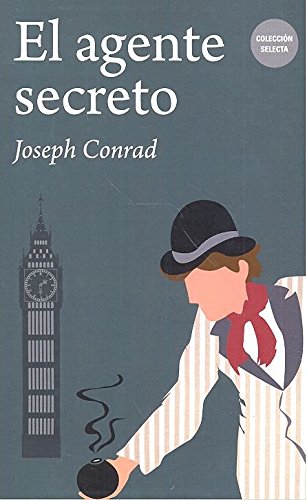
Joseph Conrad's El Agente Secreto: A Masterpiece of Espionage, Anarchy & History
Joseph Conrad's
El Agente Secreto (The Secret Agent), originally published in 1907, plunges readers into the shadowy, morally ambiguous world of late 19th-century London, exploring themes that remain chillingly relevant today. More than a century after its debut, this intricate novel continues to captivate, offering a profound commentary on political extremism, personal betrayal, and the fragile line between public duty and private tragedy. Its enduring power is perhaps best underscored by its recent resurgence in the public eye, with an acclaimed cinematic adaptation reigniting interest in Conrad's prescient vision.
Unveiling the Underbelly of 1880s London: The Premise of El Agente Secreto
At the heart of
El Agente Secreto lies Verloc, a seemingly unremarkable shopkeeper in a quiet London street. He sells cheap trinkets and household goods, but this mundane facade masks a far more perilous occupation: Verloc is a double agent, simultaneously working for the London police and a foreign embassy – widely understood to be Russian. His life is a delicate balance of deception, existing on the fringes of society, entangled in the complex web of political espionage.
Verloc's domestic life is a quiet tragedy in itself. He lives with his loyal, stoic wife, Winnie, her elderly mother, and Winnie's mentally challenged younger brother, Stevie. Winnie dotes on Stevie, treating him with the protective love of a mother, and his innocent, sensitive nature serves as a stark contrast to the cynicism and deceit that pervade the adult world around him.
Verloc's social circle consists of a motley group of anarchists – figures like Ossipon, Michaelis, and the enigmatic "Professor," a bomb-maker whose nihilistic philosophy drives him to carry explosives constantly. Initially, the police view these individuals as largely harmless, content to monitor their revolutionary pamphlets and rhetoric. However, the delicate equilibrium shatters with the arrival of Vladimir, the new first secretary of the Russian embassy. Vladimir, impatient with mere observation, pushes Verloc towards a far more dangerous mission: to commit an act of "purely destructive" terrorism that will galvanize public opinion and force the British authorities to crack down on anarchists, effectively serving as an agent provocateur. This directive sets in motion a chain of events that spirals irrevocably towards catastrophe, revealing the devastating human cost of political machinations.
A Web of Intrigue: Espionage, Anarchy, and Political Provocation
Conrad masterfully dissects the murky world of espionage, where allegiances are fluid and moral lines are constantly blurred. Verloc's existence is one of perpetual compromise, caught between the demands of his handlers and the facade of his domestic life. He is neither a hero nor a villain in the traditional sense, but a man driven by self-preservation and a desperate desire for a quiet life, ironically drawn into the very chaos he seeks to avoid.
The novel provides a scathing critique of the political landscape of its time. The anarchists, while ideologically fervent, are often portrayed as inept, naive, or absorbed in abstract theory rather than practical action. Their revolutionary zeal is undermined by their own human failings, highlighting Conrad's skepticism about grand political movements. The authorities, too, are not spared; the police are often bumbling, and the foreign powers are depicted as cynical manipulators willing to sacrifice innocent lives for strategic gain.
The concept of the "agent provocateur" is central to the narrative. Vladimir's scheme to instigate violence, rather than merely observe it, unveils a chilling aspect of state power – the willingness to create the very threats it purports to combat. This strategic manipulation of public fear and political unrest resonates powerfully even in today's complex geopolitical climate, making Conrad’s exploration of these themes eerily prescient. The novel forces us to question the nature of political violence and the true motivations behind those who instigate it.
The Greenwich Observatory Bombing: A Historical Echo
One of the most compelling aspects of
El Agente Secreto is its foundation in a real historical event. Conrad’s narrative draws inspiration from the attempted bombing of the Greenwich Observatory in 1894, an actual act of anarchist violence that shocked Victorian society. This historical backdrop lends the novel an unsettling authenticity, grounding its fictional intrigue in the anxieties of an era grappling with nascent forms of political extremism and terrorism.
The choice of the Greenwich Observatory as a target is symbolically potent. As the home of Greenwich Mean Time (GMT), it represented not just scientific progress but also the very concept of ordered time and global coordination. An attack on such an institution was an assault on the fabric of civilization itself, a nihilistic gesture aimed at disrupting universal standards. Conrad uses this historical incident not merely as a plot device but as a lens through which to examine the profound societal fears stirred by such acts. He delves into the psychological underpinnings of those who would perpetrate such violence and the ripple effects that extend far beyond the immediate target.
In his hands, the bombing becomes a catalyst for exploring the destructive potential of ideologies, the anonymity of modern urban life, and the vulnerability of seemingly stable societies to unseen threats. This profound engagement with the reality of political violence solidified
El Agente Secreto's place as one of the earliest and most insightful literary works to confront the phenomenon of terrorism.
Beyond the Thriller: Exploring Conrad's Profound Themes
While ostensibly a political thriller,
El Agente Secreto transcends genre through Conrad’s deep psychological insight and masterful narrative construction. The novel delves into profound themes that elevate it to a timeless work of literature.
The Tragedy of Winnie Verloc
Perhaps the most heartbreaking aspect of the novel is the gradual unveiling of Winnie Verloc's tragedy. Her quiet devotion to her family, particularly to Stevie, forms the emotional core of the story. She exists in a state of willful ignorance, choosing not to see the dark undercurrents of her husband's life. When Verloc’s actions shatter her carefully constructed reality, her reaction is both shocking and deeply human, transforming the political thriller into a devastating domestic drama about betrayal and irreversible loss. Her fate serves as a stark reminder of the innocent lives caught in the crossfire of larger political games.
Nihilism and Moral Decay
Conrad skillfully portrays a world where moral certainties are eroded. The Professor, with his detached embrace of destruction, embodies radical nihilism. But even characters seemingly on the side of order, like Verloc and Vladimir, demonstrate a profound moral decay, driven by expediency and a lack of genuine conviction. The novel explores how ideologies, when taken to extremes or used as cynical tools, can strip individuals of their humanity and lead to devastating consequences.
Societal Hypocrisy and Isolation
Conrad's London is a city of facades and hidden truths. From the respectable front of Verloc's shop to the grand pronouncements of the anarchists and the veiled machinations of the embassies, hypocrisy abounds. The characters, despite living in a densely populated metropolis, are profoundly isolated, unable to truly connect or understand one another. This pervasive sense of alienation contributes to the novel's bleak atmosphere and underscores the difficulty of forging genuine human bonds in a world driven by deceit. Conrad’s unique narrative style, often employing a detached, ironic voice, further emphasizes this sense of societal critique and the tragic ironies inherent in human affairs.
El Agente Secreto's Enduring Legacy and Modern Resonance
El Agente Secreto remains a literary cornerstone, celebrated for its complex characters, intricate plot, and profound thematic depth. Its exploration of political extremism, espionage, and the devastating impact of violence on ordinary lives continues to resonate with readers and critics alike. Conrad’s prescience in depicting modern forms of terrorism, state manipulation, and psychological alienation solidifies the novel's status as a work far ahead of its time. It has influenced countless authors and filmmakers, cementing its place as a quintessential political thriller and a foundational text for understanding the anxieties of the modern age.
The novel’s enduring relevance is powerfully demonstrated by its recent return to the spotlight through a critically acclaimed film adaptation. Directed by Kleber Mendonça Filho, this modern interpretation, also titled
El Agente Secreto, has captivated audiences and critics alike. The film debuted at number one at the Brazilian box office, drawing over 369,229 viewers in its opening weekend and accumulating 425,743 tickets in its first days across 1,394 screens nationwide. Its success is not merely commercial; crowned as the most awarded film at the Festival de Cannes, it garnered prestigious prizes for Best Director, Best Actor, and the Critics' Prize, and is now considered a strong contender for the upcoming Oscars. For more details on the film's impressive performance, read about
El Agente Secreto: Brazil's Box Office #1 & Oscar Hopeful.
This cinematic achievement underscores the timeless appeal of stories that delve into the shadowy worlds of espionage and political intrigue, reminding audiences that Conrad's original vision continues to resonate profoundly. The film’s impending arrival in Spanish cinemas on February 20th, a co-distribution between Elastica and La Aventura, further attests to its global impact and critical acclaim. And for information regarding its Spanish premiere, explore
El Agente Secreto: Kleber Mendonça Filho's Acclaimed Film Arrives in Spain.
Joseph Conrad's
El Agente Secreto stands as a monumental work of literature, a chillingly relevant exploration of political intrigue, human frailty, and the insidious nature of violence. Whether through its pages or its compelling new cinematic interpretation, the story of Verloc, Winnie, and the anarchists of 1880s London continues to challenge, disturb, and provoke thought, reminding us that the dark currents of history and human nature are never truly confined to the past.